

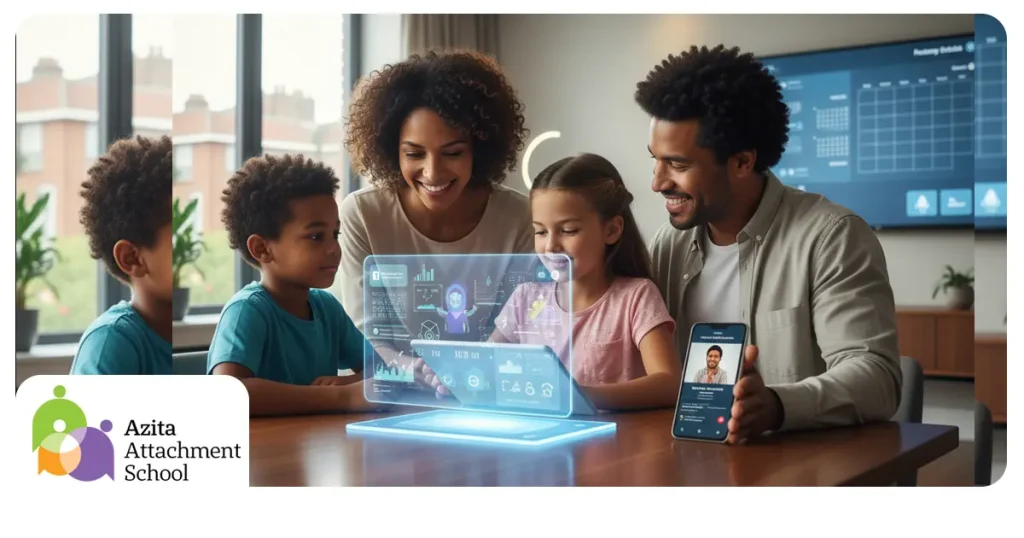
Parenting has entered a new era.
Children today learn from screens, talk to chatbots, and grow up in a world where answers are instant.
For parents, this shift is both empowering and overwhelming. Coaching in the age of AI means finding a balance between technological help and human connection.
Attachment theory reminds us:
“Children need attuned faces more than perfect feedback.”
Eye contact, tone, and emotional presence shape neural circuits for empathy.
Technology should support human connection, not replace it.
Sara’s Father, age 42:
He used an AI-based parenting app to monitor communication. It helped at first, but he realized he was analyzing charts more than listening to his daughter.
After coaching, he created daily “tech-free” time for connection — 30 minutes of shared laughter and presence.
Neuroscientists like Patricia Kuhl found that children’s brains develop empathy through live human interaction, not digital simulation.
Thus, AI can teach skills — but only humans teach love.
30-minute tech-free connection daily.
Discuss online content with curiosity.
Use AI tools for learning, not control.
Ask: “How much of my parenting is present, not digital?”
Parenting in the age of AI is not about rejecting technology, but mastering it wisely.
When used consciously, AI can expand parental insight; when overused, it steals presence.
True parenting will always rely on one irreplaceable system — the human heart.